Find where your software lacks SEO & AEO coverage. Book a Strategy Call


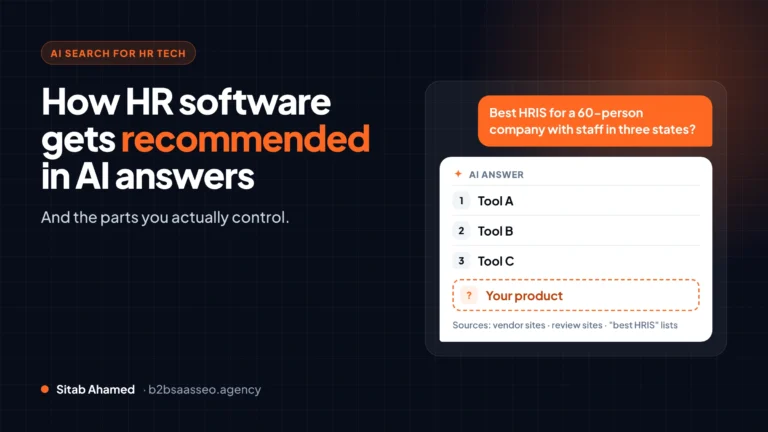
GEO (Generative Engine Optimization) works by making your brand easy for AI systems to find, understand, and trust when a buyer asks them a question. For a B2B SaaS company, that means getting your product named and cited in answers from ChatGPT, Perplexity, Gemini, and Google’s AI Overviews, during the research phase that now happens before a prospect books a demo.
It rests on three things: pages AI can retrieve, answers it can extract, and third-party proof that backs you up.
TL;DR
- GEO (Generative Engine Optimization) works by making your brand easy for AI systems to retrieve, extract, and recommend when buyers ask category questions.
- Traditional SEO is the foundation: AI models overwhelmingly cite pages that already rank on Google for relevant search queries.
- Focus on what you control: answer-first product pages, specific data and pricing facts, and credible third-party reviews and citations.
What GEO is (and isn’t)
Generative Engine Optimization (GEO) is the practice of improving how often, and how favorably, AI-generated answers mention and cite your brand. The term comes from a 2023 research paper from Princeton and collaborators, which tested which content changes increased visibility in generative engine responses. Adding citations, quotations, and statistics to content raised visibility by up to roughly 40% in their benchmark.
Treat that figure as directional. It came from a controlled test, not from live B2B SaaS search.
GEO is not a replacement for SEO, and it is not a trick. You are not gaming a model. You are making sure the model has accurate, well-structured, widely corroborated information about you to work with. You will also see the same practice called AEO (Answer Engine Optimization) or AI search optimization. The tactics overlap heavily.
How AI engines choose what to cite
The mechanics differ by platform, but most generative engines follow a similar pattern:
- Interpret the prompt. Buyers write long, conversational questions: “What’s the best SOC 2 automation tool for a 50-person startup?”
- Expand it into sub-queries. Google says both AI Overviews and AI Mode may use a “query fan-out” technique, issuing multiple related searches across subtopics and data sources to develop a response.
- Retrieve candidate pages. The engine pulls from a search index or the live web.
- Synthesize an answer. The model combines what it retrieved with what it already “knows” about the topic.
- Cite or mention sources. Some brands get a link. Some get named. Most get neither.
This gives you two routes to visibility. Retrieval means your pages are found and used for a specific answer. Model familiarity means your brand is strongly associated with a category across the web, so it comes up even without a fresh lookup. Good GEO work feeds both.
Fan-out has a practical consequence. One buyer prompt can trigger searches for pricing, integrations, alternatives, and reviews. If you only have a strong page for one of those subtopics, you lose the other slots.
Why B2B SaaS is a special case
B2B SaaS has structural traits that make AI answers matter more than they would for most industries:
- Long, research-heavy buying cycles. Buyers use AI to build a shortlist early, then arrive at your site already holding opinions.
- Buying committees. A finance lead, a security reviewer, and an end user each ask different questions. AI answers shape all of them.
- Comparison-driven demand. Prompts like “X vs. Y,” “alternatives to X,” and “best tool for [use case]” are the SaaS research pattern, and AI engines answer them directly.
- Crowded categories. If five tools do roughly the same thing, the engine needs a reason to pick yours. Clear positioning and external proof supply that reason.
Gartner predicted in 2024 that traditional search engine volume would drop 25% by 2026 as people shift to AI chatbots and virtual agents.
The Retrieve, Extract, Corroborate model
Most GEO tactics fit into three layers. Work through them in order, because each depends on the one before it.
1. Retrieve: make sure AI can reach and rank your pages
If a page can’t be crawled, indexed, or ranked, it won’t be retrieved. This layer is classic SEO, and it still decides most outcomes.
- Allow search and AI crawlers in robots.txt, and confirm key pages aren’t blocked, noindexed, or hidden behind JavaScript that fails to render.
- Keep a clean site architecture and link your commercial pages (pricing, integrations, use cases) to each other.
- Cover the full set of sub-queries around your category, not just the head term.
Google’s own guidance supports this. It states that specific optimization isn’t required for AI Overviews and AI Mode, and existing SEO fundamentals continue to be worthwhile.
2. Extract: make your answers easy to lift
Once retrieved, the model has to pull a usable answer from your page. Pages that bury the point lose to pages that state it.
- Lead with the answer. Put a direct two- or three-sentence answer under each question-style heading, then add detail.
- State the facts buyers ask about. Who the product is for, who it is not for, pricing structure, integrations, security and compliance, and implementation time. AI answers frequently draw on exactly these.
- Use specific, attributable claims. “Reduced onboarding time from X to Y for [customer type]” is easier to cite than “dramatically faster onboarding.” That also fits what the Princeton study found: statistics and sourced claims helped.
- Use clear structure. Descriptive headings, short paragraphs, comparison tables, and definition-style sentences.
- Keep structured data accurate. Google notes there’s no special schema.org structured data you need to add for AI features. Schema won’t force a citation, but it helps clarify entities (Organization, SoftwareApplication, FAQPage), so keep it correct and matched to the visible text.
3. Corroborate: get other sources to say the same thing
This is the layer most SaaS teams skip, and it often separates the brands AI recommends from the ones it ignores. Engines are cautious about self-promotion. A claim that appears on your site and on independent sources is far more credible than one that appears only on your site.
Sources worth building presence on:
- Software review platforms such as G2 and Capterra
- Industry publications, analyst mentions, and “best of” roundups in your category
- Partner and integration directories
- Community discussions where practitioners recommend tools
- Podcasts, webinars, and conference talks with transcripts
- Customer case studies published by the customer
Which sources matter depends on your category, so don’t guess. Run your target prompts (step 1 below) and note which domains the AI answers cite. Those are your targets.
Consistency matters too. Describe your product the same way everywhere: category, one-line positioning, and key use cases. If your homepage says “revenue intelligence platform” and your G2 profile says “sales analytics tool,” you’re splitting your signal.
GEO vs. SEO
| Traditional SEO | GEO | |
|---|---|---|
| Goal | Rank a page for a keyword | Get your brand mentioned or cited in an AI answer |
| Unit of success | Position on a results page | Inclusion, citation, and framing in a synthesized answer |
| Typical query | Short keyword phrases | Long, conversational prompts |
| Main signals | Relevance, links, page experience, authority | Retrievability, extractable answers, third-party corroboration, brand consistency |
| Measurement | Rankings, clicks, conversions | Citation and mention rate, share of voice across prompts, AI referral traffic |
| Predictability | Relatively stable | Probabilistic, varies by run and platform |
The two share a base: crawlability, quality content, authority, and a fast site.
How to start: a 6-step plan
Step 1: Build a buyer prompt set. List 30 to 50 prompts your buyers would plausibly ask across the funnel: problem-aware (“how do I reduce churn in a usage-based product”), category (“best customer success platforms”), comparison (“[Competitor] vs. [You]”), and decision-stage (“is [You] SOC 2 compliant”). Source them from sales calls, support tickets, and your own keyword data.
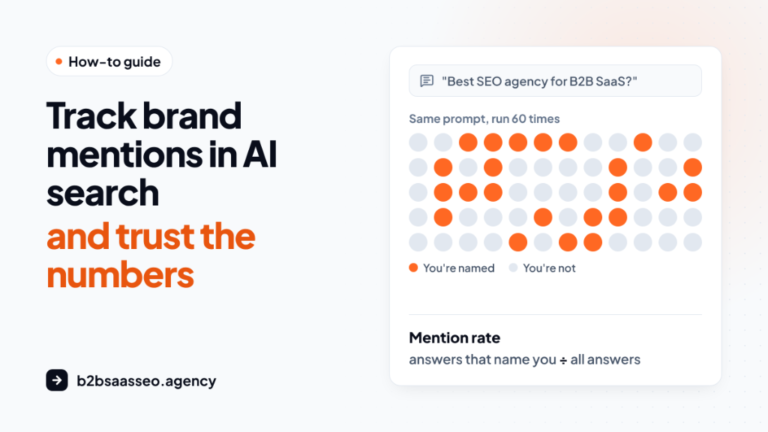
Step 2: Baseline your visibility. Run each prompt across the platforms your buyers use. Record whether you’re mentioned, whether you’re cited with a link, how you’re described, which competitors appear, and which sources the engine cites. Repeat each prompt a few times, since answers vary between runs.
Step 3: Fix retrieval problems first. Audit crawl access, indexation, and rendering for your pricing, integrations, use-case, and comparison pages. A page that can’t be retrieved can’t be cited.
Step 4: Rebuild your money pages to answer questions. Rework core pages so each opens with a direct answer and includes the facts buyers ask about. Add comparison and “alternatives” content that is honest about where you fit and where you don’t. Balanced pages are more credible to both readers and models.
Step 5: Publish original, citable evidence. Original benchmarks, customer data (with permission), and clear methodologies give AI something worth citing and give other sites something worth linking to.
Step 6: Build third-party presence and iterate. Use the cited-sources list from step 2 to prioritize reviews, publications, and communities. Re-run your prompt set monthly, compare against the baseline, and adjust.
For help running this end to end,
How to measure GEO
GEO measurement is still imperfect, so be honest about what the data can and can’t tell you.
- Mention rate and citation rate across your prompt set, tracked over time. Individual answers are noisy, so look at trends, not single runs.
- Share of voice against two or three named competitors on the same prompts.
- AI referral traffic in analytics. Look for visits from chatbot and AI search domains, but expect undercounting, since many AI-influenced visits arrive as direct or branded traffic.
- Branded search demand as a lagging indicator.
- Self-reported attribution. Add “How did you hear about us?” to demo forms and listen for “ChatGPT” or “I asked an AI tool.”
- Pipeline impact. Tie the above to qualified opportunities where you can.
Google notes that sites appearing in its AI features are included in overall search traffic in Search Console, within the Performance report under the “Web” search type. That means you can’t isolate AI Overview traffic there, which is another reason to combine several signals.
Common mistake
- Treating GEO as separate from SEO. If your pages aren’t retrievable and credible, no GEO tactic fixes that.
- Chasing hacks. Hidden text, keyword stuffing, and fake reviews can damage trust with both search engines and users.
- Publishing generic content. AI engines can produce generic answers on their own. They have no reason to cite a page that adds nothing.
- Ignoring third-party signals. Optimizing only your own site covers one of the three layers.
- Promising fixed results. Visibility in AI answers changes with models, prompts, and platforms. Anyone guaranteeing placement is overselling.
- Measuring once. A single screenshot of one prompt proves little. Track a set over time.
Frequently asked questions (FAQs)
Is GEO different from SEO?
GEO builds on SEO. Both need crawlable, high-quality, authoritative content. GEO adds a focus on being cited inside AI-written answers, which means answer-first structure, original evidence, and strong third-party corroboration. Strong SEO is the foundation, but ranking well doesn’t guarantee an AI engine will mention your brand.
How long does GEO take to show results?
There’s no reliable benchmark. Changes to crawlable, well-structured pages can be picked up once they’re re-crawled, while building third-party presence and brand familiarity usually takes months. Be cautious of anyone promising fixed timelines, since AI answers vary by platform and change as models update.
Do I need special schema markup for GEO?
No. Google says no special structured data is needed for its AI features. Schema is still worth using to clarify your organization, product, and FAQs, as long as it matches the visible page content. Treat it as a clarity aid, not a ranking lever.
How do I measure GEO ROI?
Track mention and citation rates across a fixed prompt set, share of voice against competitors, AI referral traffic, branded search, and self-reported attribution on demo forms. Connect these to pipeline where possible. No single metric is reliable alone, so look for trends across several.
Which AI platforms should a B2B SaaS company prioritize?
Start where your buyers research. Test your prompt set across ChatGPT, Perplexity, Gemini, Microsoft Copilot, and Google’s AI Overviews and AI Mode, then focus on the platforms where competitors appear and you don’t. Sales conversations and “how did you hear about us” data help confirm which ones matter.
Conclusion
GEO works for B2B SaaS because buyers now form their shortlists inside AI answers, and those answers favor brands that are easy to retrieve, easy to quote, and backed by independent sources. The work is mostly strong SEO plus clearer answers and more third-party proof, not a separate bag of tricks.