Find where your software lacks SEO & AEO coverage. Book a Strategy Call


A buyer opens ChatGPT and types: “What’s the best HRIS for a 60-person company with staff in three states?” Say the answer names Gusto, Rippling and BambooHR. Your product isn’t there, even though it was built for exactly that company.
That’s not random, and it’s not an ad. AI tools recommend HR software by repeating what the pages they read say about it. If those pages don’t mention you, or describe you vaguely, the AI can’t name you.
Some of those pages are yours, which means part of the answer is in your hands. This guide shows how AI tools pick HR software, what the data says they cite, and which parts you control, which you can only influence, and which you can’t touch. It’s written for HR tech SaaS teams. It doesn’t cover paid ads.
TL;DR
- AI tools name HR software by reading pages that rank: vendor sites, review sites, “best HRIS” lists, YouTube and forums.
- Your own site matters more than most teams think. In one payroll and HRIS dataset, 45% of citations pointed to the brands’ own websites.
- You control your site’s facts. You influence reviews, lists and mentions. You can’t control which tools show up in any single answer.
- Measure how often you’re named across many runs, not where you rank in one answer.
How does an AI tool decide which HR software to recommend?
It uses two sources: what it learned during training, and what it finds in a live web search when it answers.
Think of a smart new hire. They read a lot of articles last year, so they have opinions already. Before answering a tricky question, they also Google it. AI tools work the same way.
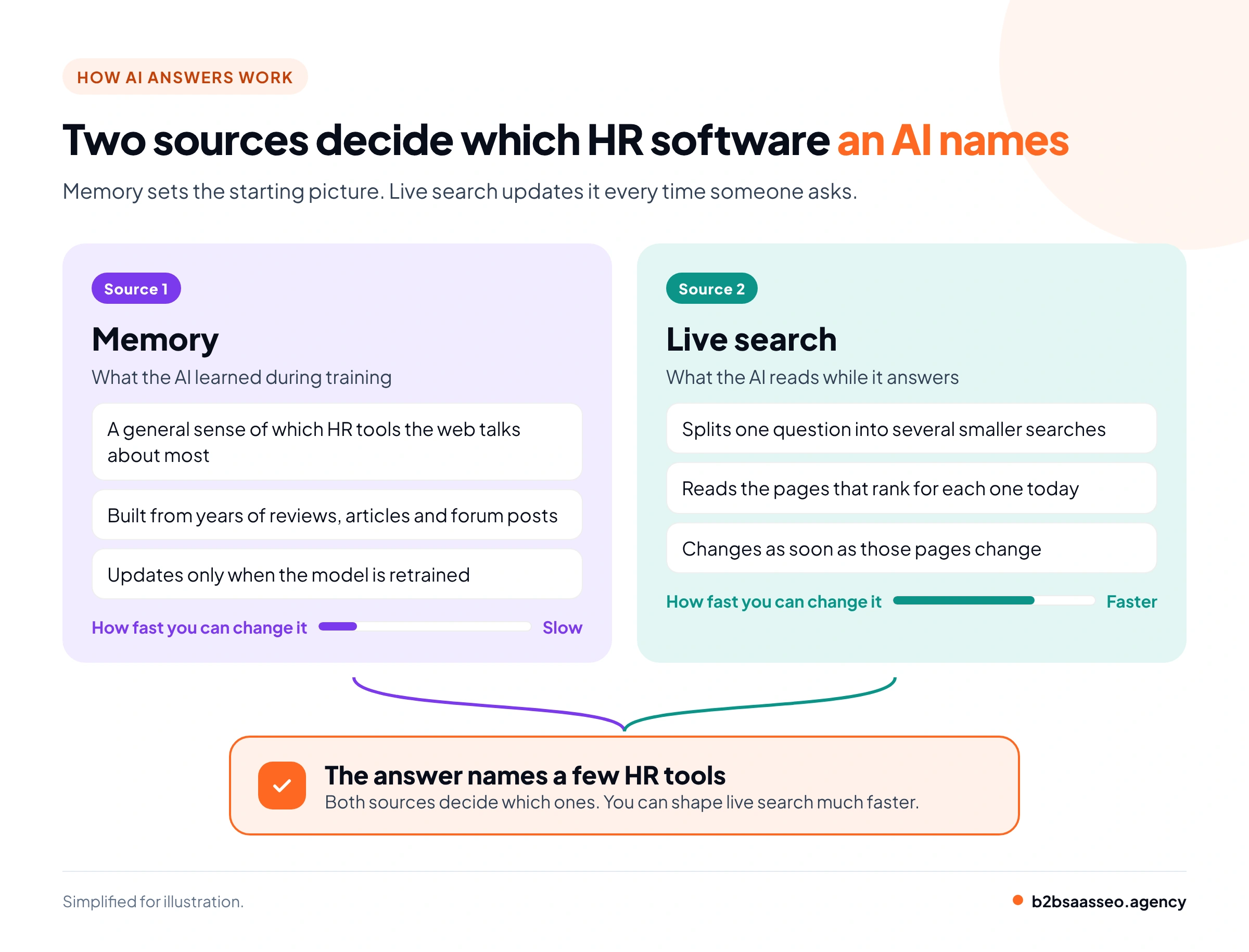
Memory is the AI’s general sense of a category: which HR tools come up again and again across the web. Big brands that the web has discussed for years have a head start here. It changes slowly, because it only updates when the model is retrained.
Live search is what the AI reads right now. Google says its AI Overviews and AI Mode are built on its core Search ranking systems. The model also uses query fan-out: it splits one question into several related searches. The HRIS question above might become:
- “HRIS for small business”
- “payroll software for multi-state employees”
- “HRIS pricing per employee”
- “BambooHR vs Rippling”
The AI reads the pages that rank for those searches, then writes a short answer naming a few tools. So if you don’t rank for the smaller searches, you’re rarely read. We covered how to win those searches in our guide on SEO for HR tech SaaS.
What do AI answers about HR software actually cite?
Mostly vendor websites, then a mix of video, publishers, review sites and forums. Parse, an AI visibility tracker, publishes data on payroll and HRIS software in AI answers. Its numbers come from 1,895 responses from ChatGPT and Google AI Mode, last updated November 3, 2026.
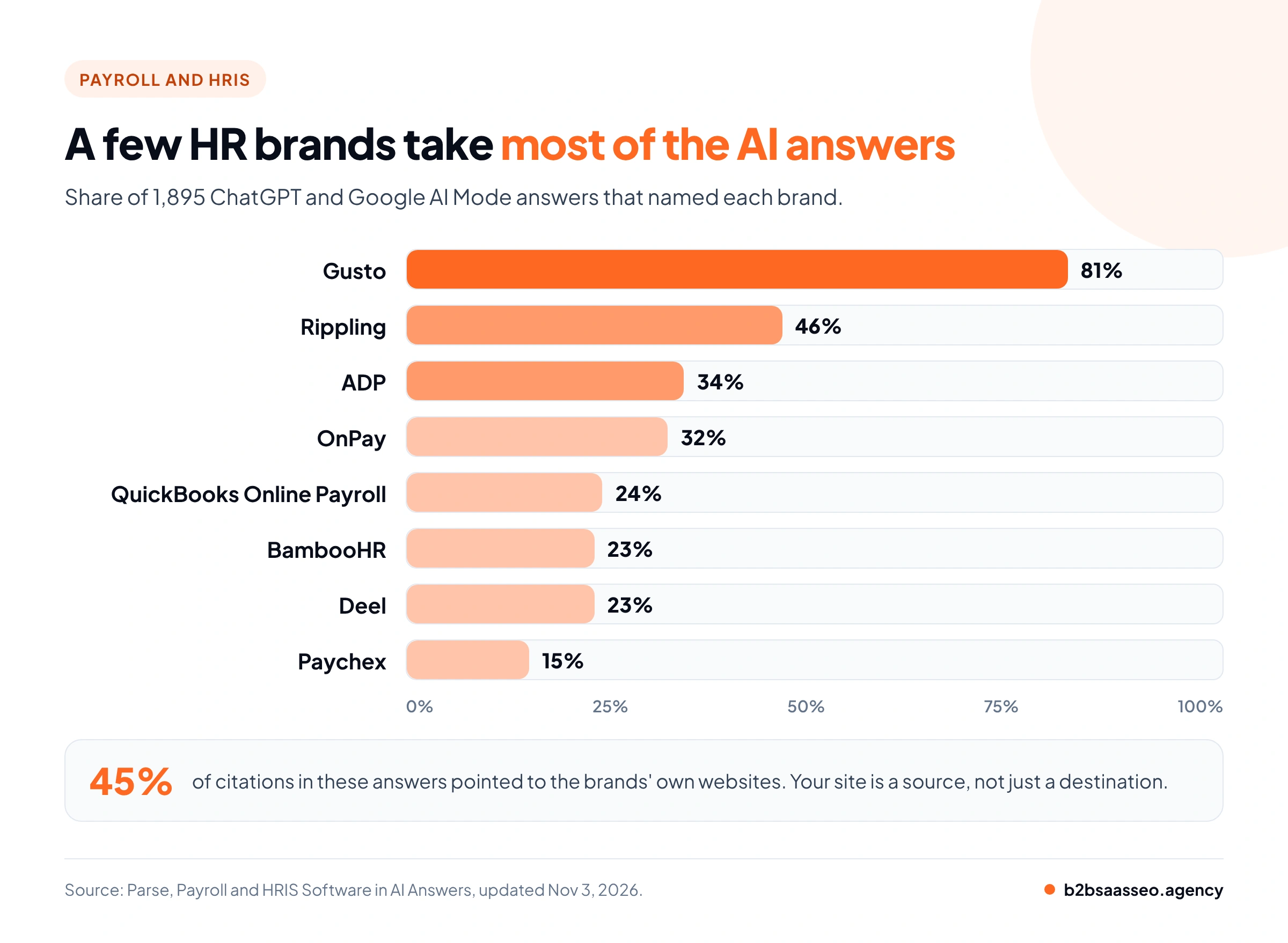
Three things stand out:
Why do the same few brands win? Mostly because the web talks about them more. Ahrefs studied 75,000 brands to see what links to showing up in Google’s AI Overviews. The strongest factor was how often the brand was mentioned across the web. It correlated far more strongly than backlinks (0.664 vs 0.218). That’s a correlation, not proof of cause. But it fits what you’d expect: a tool the web keeps mentioning is a tool the AI keeps naming.
“Best” lists play a big part in this. In Ahrefs’ study of 750 recommendation prompts in ChatGPT, “best X” lists made up 43.8% of the pages cited. Brands placed higher on those lists were more likely to be recommended, though again that’s a correlation.
Treat Parse’s numbers as one dataset, not a law. Its full method isn’t on the page, and it covers payroll and HRIS. Recruiting, performance or benefits software may look different. Run your own prompts before you plan (section 6 shows how).
What can you control, influence or not touch?
You control your own site. You can influence what other sites say about you. You can’t control which tools appear in any single answer. Spend your effort in that order.
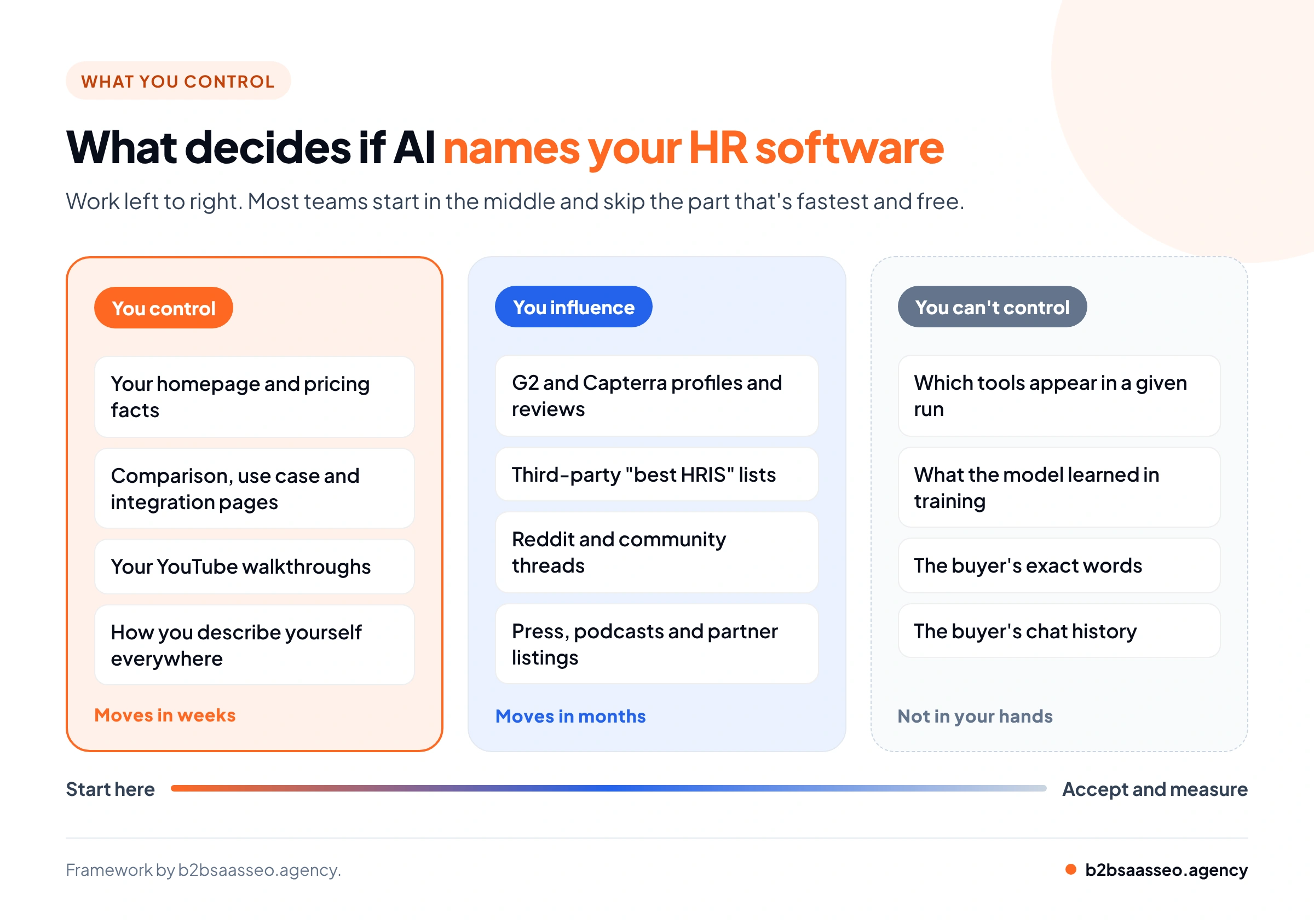
| Control Level | What’s in it | How fast it moves |
|---|---|---|
| You control | Your homepage, pricing, comparison, use case and integration pages; your YouTube videos; how you describe yourself everywhere | Weeks, once pages are indexed |
| You influence | Review profiles and reviews, third-party “best HRIS” lists, Reddit and community threads, press and analyst mentions | Months |
| You can’t control | Which tools appear in a given run, what the model learned in training, the buyer’s own wording and chat history | Not in your hands |
Most teams start in the middle, chasing list placements and Reddit threads. Start with what you control. It’s faster, it’s free, and every third-party writer who researches you will read your site first.
How do you make your HR software easy to recommend?
Give AI tools plain, specific facts they can quote, and put them everywhere a buyer or an AI might look.
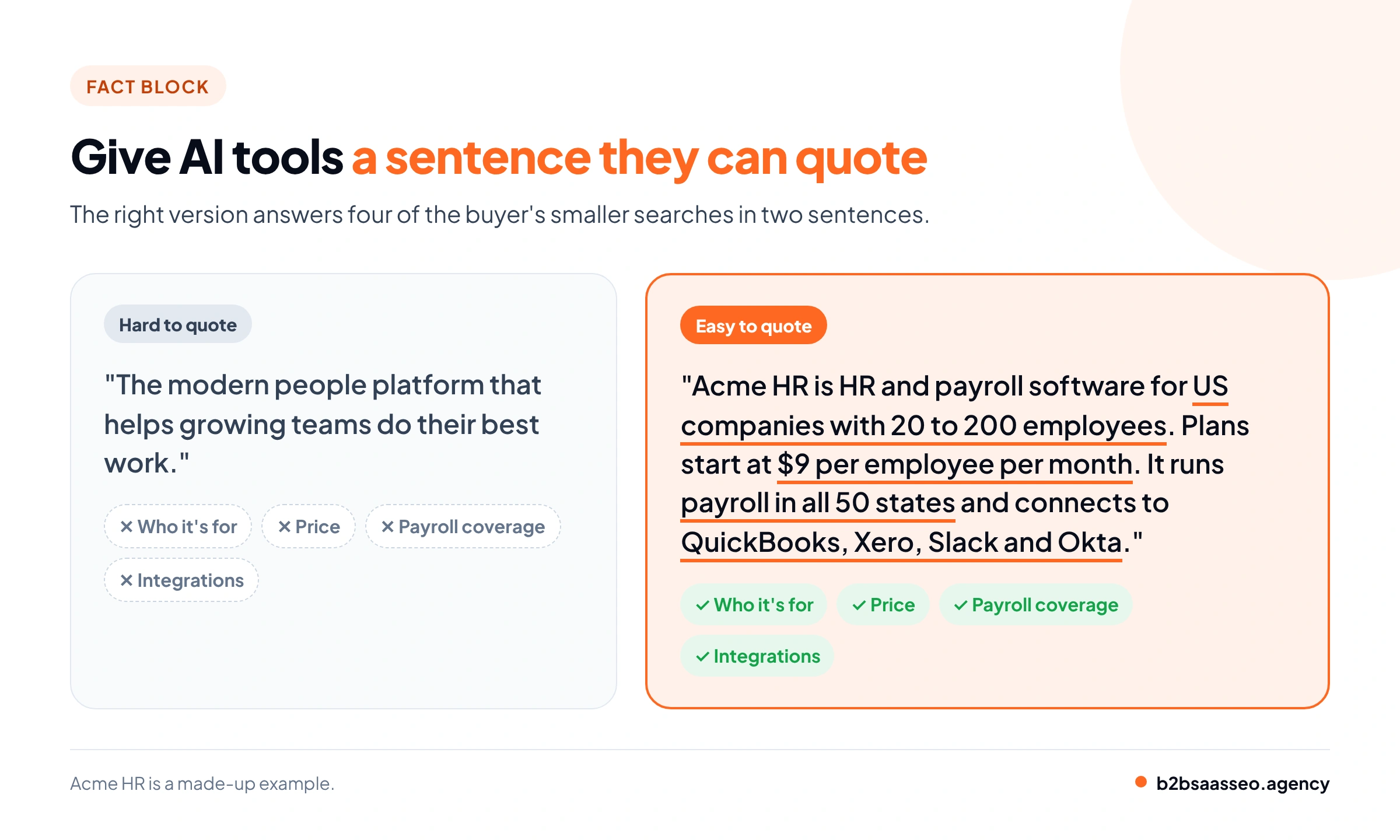
1. Write a fact block on your homepage and pricing page. One short paragraph that says who you’re for, what you do, what it costs and what it connects to. Compare:
- Hard to quote: “The modern people platform that helps growing teams do their best work.”
- Easy to quote: “Acme HR is HR and payroll software for US companies with 20 to 200 employees. Plans start at $9 per employee per month. It runs payroll in all 50 states and connects to QuickBooks, Xero, Slack and Okta.”
(Acme HR is a made-up example.) The second version answers four of the fan-out searches in two sentences. An AI can’t recommend you for “multi-state payroll under 200 employees” if your site never says that.
2. Say the same thing everywhere. Use the same description, company size range and starting price on your site, G2, Capterra, LinkedIn and app marketplaces. If your Capterra profile still shows last year’s price, an AI may repeat it. These are your entities: the facts that tell search engines and AI who you are.
3. Publish a page for each sub-question. Alternatives, comparison pages, use case pages by company size or industry, pricing and integrations. These are the pages that rank for the smaller searches the AI runs. Our HR tech SEO guide lists them in build order.
4. Put a walkthrough on YouTube. Name it the way buyers search: “Running multi-state payroll in Acme HR (5-minute walkthrough)”. Add a written summary in the description. Video is one of the third-party sources AI tools read most in this category.
5. Keep key pages current. Update pricing, integrations and comparison pages when something changes, and show the date. In Ahrefs’ study of best-of lists, 79.1% of the cited lists had been updated in 2025, the year of the study. Only real updates count. Changing the date without changing the page doesn’t help.
How do you influence what other sites say about you?
Earn your place on the pages AI tools already read: review sites, “best HRIS” lists and community threads. You can’t write these pages, but you can give their authors good reasons to include you.
- Review sites: Ask happy customers for a review right after a win, such as a first payroll run with no errors or a smooth renewal. Reply to reviews, including the bad ones. Keep your profiles complete and current. Our glossary entry on SaaS directory listings covers which ones matter.
- “Best HRIS” lists: Ask ChatGPT and Perplexity your buyers’ questions and note every list they cite. Then pitch each author with something real: a new feature, a free account to test, or data they can use. Earning editorial mentions on those pages is the core of our SaaS link building work.
- Communities: HR managers ask for software advice in Reddit’s HR and small-business groups. Answer as a named person, say where you work, and help even when your product isn’t the answer.
- Press and partners: Original data about HR work, partner marketplace listings and podcast interviews all add to the number of places your brand is mentioned.
Buying mentions doesn’t work. Google says chasing inauthentic mentions across the web isn’t as helpful as it might seem, and fake reviews break review site rules. A paid spot on a low-quality list can also put your brand next to pages buyers don’t trust.
How do you measure AI visibility when answers keep changing?
Count how often you’re named across many runs, and ignore where you rank in any single answer.
AI answers change almost every time. In a study by SparkToro and Gumshoe, about 600 volunteers ran the same 12 prompts in ChatGPT, Claude and Google’s AI nearly 3,000 times. The chance of getting the same list of brands twice was under 1 in 100, and the same list in the same order about 1 in 1,000. But some brands appeared in 60% to 90% of answers for a given intent. The list moves around. How often you appear is steadier.
So track your visibility rate: the share of answers that name you.
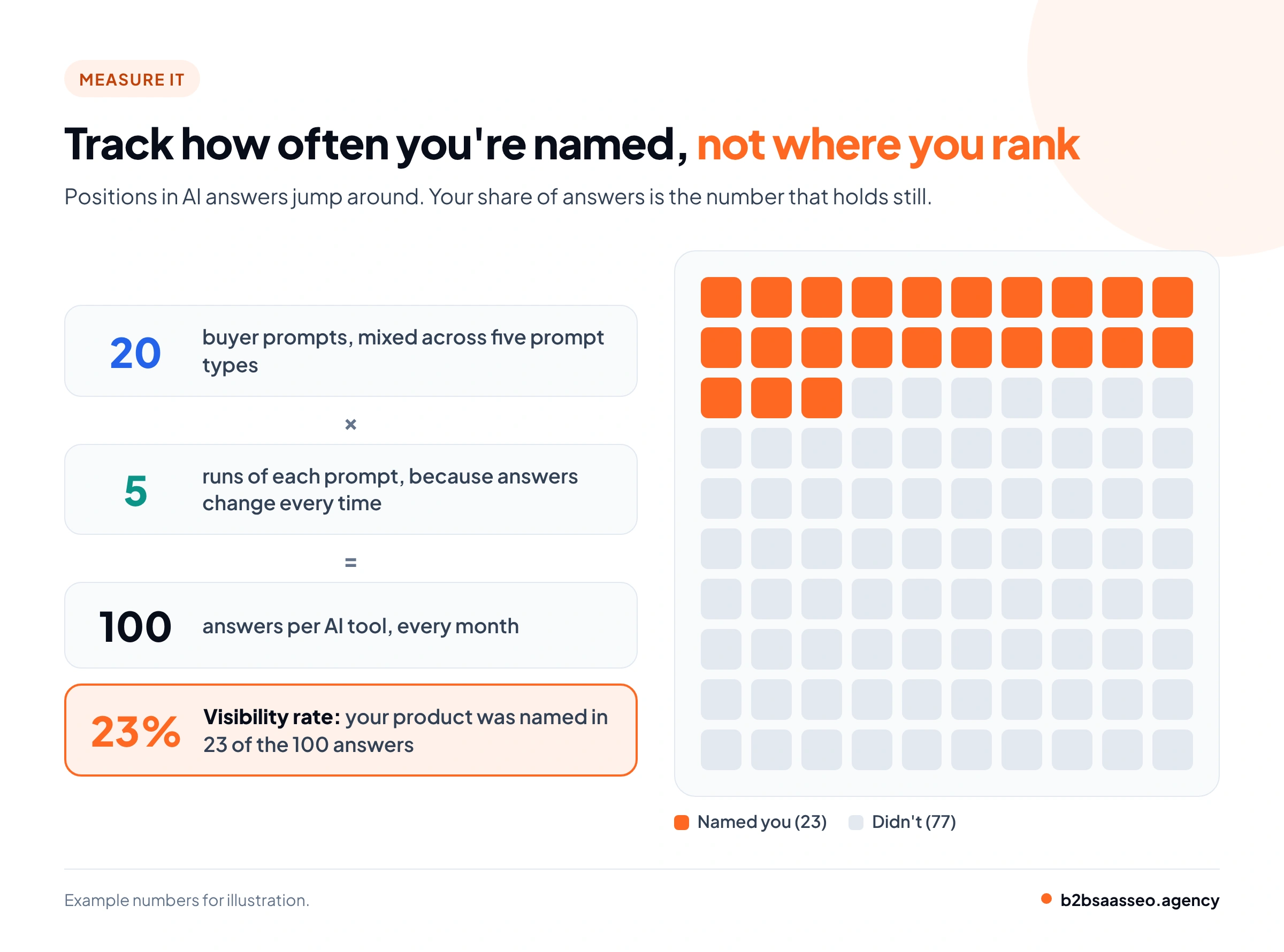
Here’s how to set it up:
- Write 20 prompts your buyers would ask. Mix the five types in the table below.
- Run each one 5 times in ChatGPT, Perplexity and Google AI Mode. That’s 100 answers per tool.
- Count the answers that name you, and note which sources each answer cites.
- Repeat monthly and compare. Look at the trend over three months, not one month.
| Prompt type | HR software example |
|---|---|
| Category | “What’s the best HRIS for a small business?” |
| Company size or industry | “Best payroll software for a 40-person restaurant group” |
| Situation | “HR software for a remote team in 10 US states” |
| Integration | “Which HR tools integrate with QuickBooks and Slack?” |
| Comparison or switching | “Is there a cheaper alternative to Rippling?” |
The cited sources are the useful part. If every answer cites the same Forbes list and you’re not on it, you know which author to pitch. Our guide on tracking brand mentions in AI search covers the manual method, and our roundup of AI visibility tools covers tools that run it for you.
What should you not do?
Skip anything that tries to trick the AI instead of informing it. It rarely works for long, and some of it can hurt you.
- Fake or incentivized reviews without disclosure: They break review site rules and erode trust when buyers spot them.
- Undisclosed paid spots on “best” lists: Buyers who spot a pay-to-play list stop trusting everything on it, including you.
- Spam in Reddit threads: Moderators remove it, and users call it out in replies.
- Special files or hidden text “for AI”: Google says its AI features need no special schema, no llms.txt file and no AI-specific rewrites. Clear pages written for buyers are what it reads.
- Believing anyone who guarantees mentions: Nobody can guarantee your product gets named in AI answers. That includes us. You can make your brand easier to understand, trust and recommend. You can’t own the answer.
Frequently Asked Questions
A competitor is named in almost every answer. How long until we show up too?
Usually months, not weeks. Your own pages can be read within weeks of being indexed. Third-party lists and reviews take longer to change, and the AI’s memory changes only when the model is retrained. Track your visibility rate monthly so you see early movement.
Should we publish our own ‘best HRIS’ list with us at number one?
Ahrefs found these self-promotional lists do get cited by ChatGPT. If you publish one, say clearly that it’s your list, include rivals fairly, and say who each one suits better. A list that reads like an ad helps you with neither buyers nor reviewers.
Do schema markup or an llms.txt file help AI recommend us?
For Google’s AI features, no special schema or llms.txt file is needed, according to Google’s own guide. Normal structured data still helps your pages show well in regular search results. Your time is better spent on the fact block and the core buyer pages.
What should you do next?
Run five of the prompts from the table in ChatGPT today, five times each. Note whether you’re named and which sources each answer cites. That list of sources is your to-do list.
Want help reading the results? Book a strategy call. We’ll run your buyers’ prompts in ChatGPT, Perplexity and Gemini and show you which sources decide your category’s answers. You keep the 90-day plan whether or not we work together.