Find where your software lacks SEO & AEO coverage. Book a Strategy Call


You’re doing a bit of everything. A blog post every week, some LinkedIn, a few Google Ads, outbound when someone has time. Traffic goes up. Demo requests don’t. And the deals you do close often start with “we’d already narrowed it down to you and one other vendor.”
That last line is the whole story. B2B software is now mostly chosen before the buyer talks to anyone at your company.
So of all the B2B SaaS marketing strategies you could run, the one that works best in 2026 is search-led. Make SEO and AEO (answer engine optimization, or getting your product named in AI answers) your main engine. Then add the two or three other strategies that fit your stage.
We’re a B2B SaaS SEO and AEO agency, so yes, we have a bias. We’ll point out where it shows, and we’ll tell you when search shouldn’t come first. This guide is for seed to Series B teams with a small marketing crew. It covers 12 strategies, how to pick by stage, a 90-day plan and the numbers to track. It doesn’t cover sales process or pricing.
TL;DR
- Lead with search. Most buyers rank their favorite vendors before they talk to sales, using Google, AI chatbots and review sites.
- SEO and AEO are one engine. AI answers mostly cite pages that already rank in search.
- Pick two or three support strategies that fit your stage, not all 12.
- Judge every strategy by the pipeline it creates, not by traffic or likes.
What is a B2B SaaS marketing strategy?
A B2B SaaS marketing strategy is your plan to get on a buyer’s shortlist, turn that interest into pipeline, and keep customers paying every month.
A strategy is a choice about where to show up and why. Tactics are the things you do once you’re there. Most teams have plenty of tactics and no strategy tying them together:
- Tactic: “Publish two blog posts a week.”
- Strategy: “Be on the shortlist when finance leads at Series A startups look for spend management software.”
The strategy tells you which posts to write. The tactic alone doesn’t.
Three things make B2B SaaS different from selling most other products:
- You sell a subscription. A customer who cancels after three months may never pay back what it cost to win them. Keeping customers is part of marketing’s job.
- A group buys, not one person. The founder might find you, but finance, IT and the people who’ll use the tool all get a vote. Each one needs a different answer from you.
- Buying takes time, and most of it happens without you. 6sense’s 2025 survey of more than 4,000 B2B buyers put the average buying cycle at about 10 months. That average leans toward larger purchases; a $200-a-month tool sells faster. But even quick deals start with research you never see.
Which B2B SaaS marketing strategy should come first?
Start with search. That’s where buyers build the shortlist, and the shortlist decides most deals.
Buyer surveys from 6sense and G2 show how early the decision now happens:
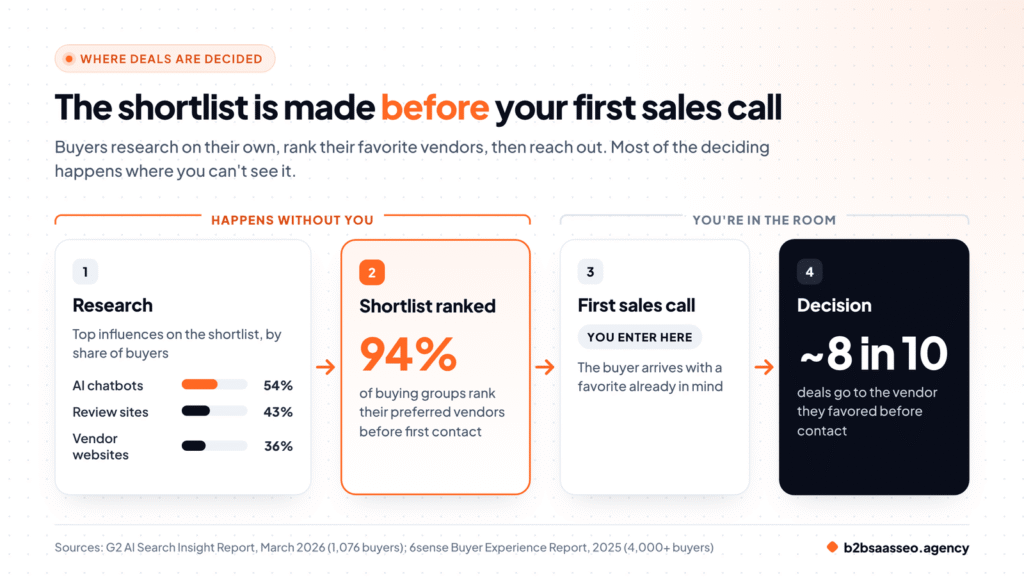
- Buyers pick a favorite before they call you. In 6sense’s 2025 survey, 94% of buying groups had already ranked their preferred vendors before first contact with a seller. The vendor they favored at that point went on to win roughly 8 deals in 10.
- That ranking happens in Google and AI chatbots. In G2’s March 2026 survey of 1,076 B2B software buyers, AI chatbots were the top influence on shortlists. 54% named them, ahead of review sites (43%) and vendor websites (36%). Half (51%) said they start research in an AI chatbot more often than in Google, and about 80% still use Google at some point. G2 runs a review site, so read its review numbers with that in mind.
Put simply: by the time someone fills in your demo form, they’ve done most of the deciding. They did it on Google, in ChatGPT and on G2.
Fix three things before you pick any channel
Every strategy below sends people to your website. These three decide whether those visits turn into pipeline:
- Know exactly who you sell to. Write down one ideal customer profile: company size, the job they hire your product for and what they use today. If it takes a paragraph, it isn’t one profile yet.
- Say what you do in one sentence a buyer would repeat. “The all-in-one platform for modern revenue teams” is forgettable. “Call recording for sales teams who sell on Zoom and live in HubSpot” tells the right buyer they’re in the right place.
- Make your pricing and demo pages do their job. If the demo form asks 11 questions and the pricing page only says “Contact us”, you’re paying to fill a leaky bucket. Cut the form to what sales actually uses, show a starting price if you can, and say what happens after someone books. Our glossary entry on the demo booking path covers the details.
Why should SEO and AEO be your main engine?
Because search sits exactly where buyers make the shortlist, and it keeps working after you stop paying for it. Three reasons, in plain terms:
1. Search meets buyers who are already looking. Ads, outbound and events interrupt people. Search reaches them in the middle of a decision. Someone typing “HubSpot alternatives for startups” is far closer to a demo than someone scrolling LinkedIn.
2. It compounds. Think of paid ads as renting and SEO as owning. Renting is quicker to move into, and you’re out the day you stop paying. Owning costs more upfront, then keeps paying you back. A good comparison page published this quarter can bring demos for years. A paid click works once.
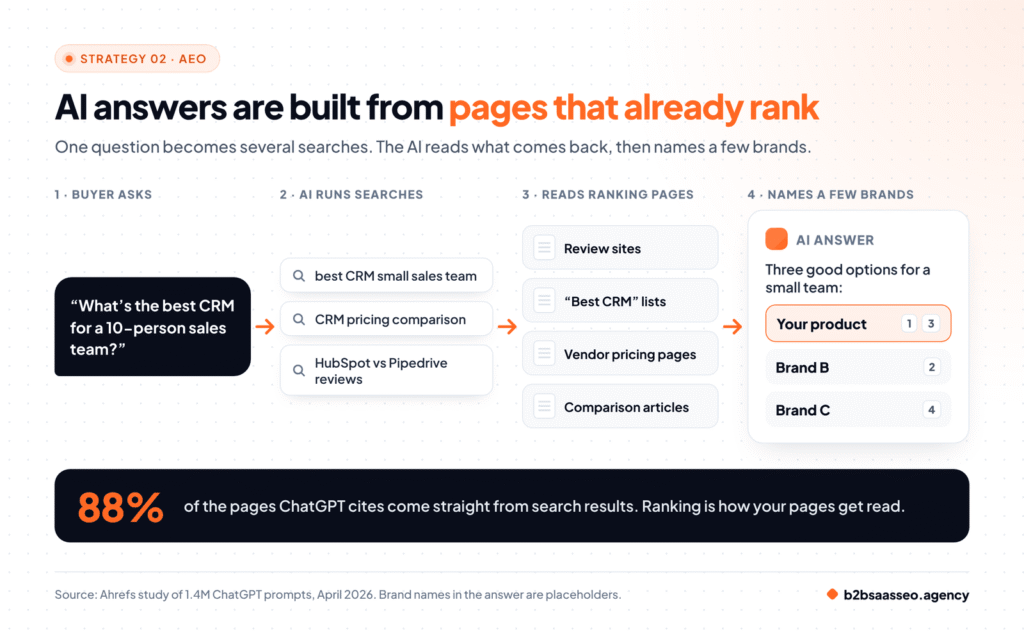
3. AEO runs on SEO. AI tools don’t have a separate internet. When ChatGPT, Perplexity or Google’s AI Overviews search the web to answer a question, they mostly pull from pages that already rank. In Ahrefs’ study of 1.4 million ChatGPT prompts (April 2026), 88% of the pages ChatGPT cited came straight from search results. Google says its AI Overviews and AI Mode need no special tricks, only normal search basics. Ranking gets your page read by AI. Clear, specific writing gets it quoted. We explain the mechanics in how GEO works for B2B SaaS companies.
There’s an early sign this traffic is worth having. On Ahrefs’ own site, AI search sent 0.5% of visitors but 12.1% of signups over 30 days in mid-2025. That’s one company, not a benchmark. But it makes sense: someone who arrives from an AI answer has usually compared options already.
The trade-offs:
- It’s slow. Expect months before SEO shows up in pipeline, and longer on a new domain or in a crowded category. That’s why it pairs with faster strategies below.
- Nobody can guarantee AI mentions. AI answers change from one run to the next. You can raise the odds that you’re named. You can’t own the answer, and anyone who promises otherwise is guessing. That includes agencies like us.
When should SEO not come first?
When nobody searches for what you sell yet, or when you need pipeline this month. Three cases:
- You’re creating a new category. If no one types your category’s name into Google, there’s little to rank for. Lead with founder-led content and outbound until the category has a name people use. You can still rank for the problem, described in your buyers’ own words.
- You need pipeline in the next 30 to 60 days. SEO won’t save this quarter. Lean on outbound and high-intent ads now, and start SEO alongside them so next year looks different.
- You haven’t found product-market fit. If who you sell to changes every month, the pages you write today will target the wrong buyer. Talk to customers first.
Not sure which camp you’re in? On a 45-minute strategy call, we check how your top three competitors show up in search and how ChatGPT, Perplexity and Gemini describe your category. You leave with a 90-day plan, whether or not we work together. Book a strategy call →
Which 12 B2B SaaS marketing strategies actually work?
These 12 work for B2B SaaS teams in 2026. The first three build your search engine. The other nine stand on their own, and you only need the few that fit your stage (there’s a table for that further down).
| # | Strategy | What it gets you | How fast it pays off |
|---|---|---|---|
| 1 | Bottom-of-funnel SEO | Demos from buyers already comparing tools | Slow start, then compounds |
| 2 | AEO (visibility in AI answers) | Named when buyers ask AI for options | Slow start, then compounds |
| 3 | Third-party presence | Listed where buyers and AI check you | Medium |
| 4 | Buyer-first content | Trust, plus material for every other channel | Slow |
| 5 | Founder-led LinkedIn | Known before buyers search | Medium |
| 6 | Partner and integration marketing | Buyers who already trust a partner | Slow |
| 7 | High-intent Google Ads | Demos this month | Fast, stops when spend stops |
| 8 | ABM and outbound | Meetings with accounts you choose | Fast to medium |
| 9 | Product-led growth | Users who sell themselves on the product | Medium |
| 10 | Webinars and small events | Buying groups that learn together | Medium |
| 11 | Onboarding and lifecycle email | Customers who stay past month one | Fast once set up |
| 12 | Customer advocacy and expansion | Reviews, referrals and bigger accounts | Medium |
The map below compares them on two things a small team cares about: how fast each one brings pipeline, and how long it keeps working after you stop. The placements are our judgment, not measured data.

Strategies 1 to 3: get on the shortlist
1. Are you ranking for the searches buyers make right before a demo?
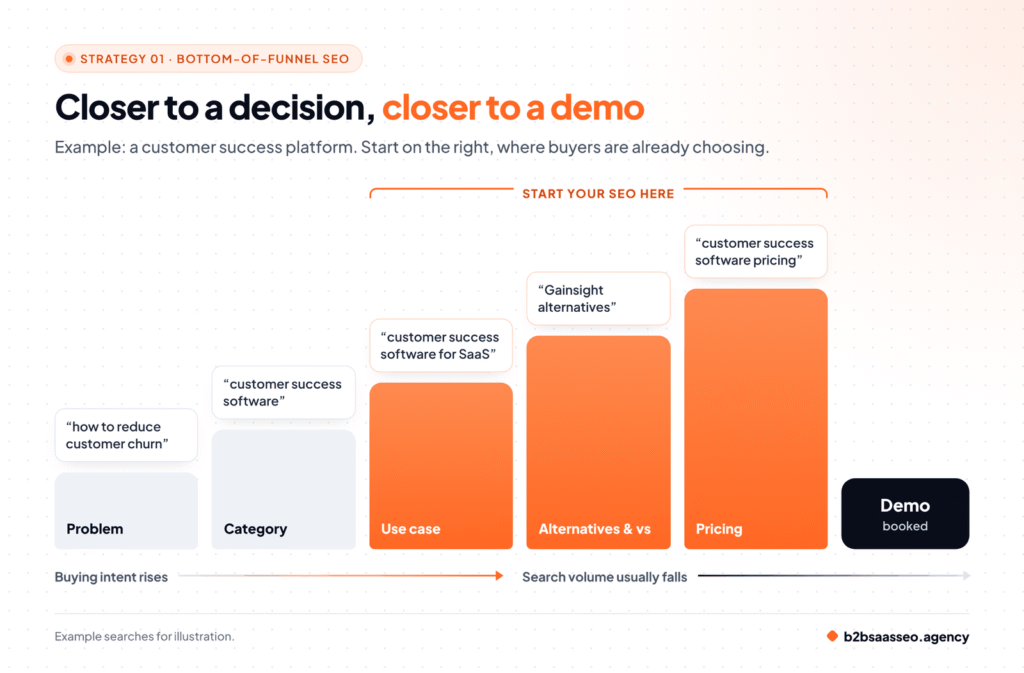
Start your SEO with bottom-of-funnel pages: pages for people who are already choosing software, not just learning about a problem. These searches have less volume, but the people behind them are close to buying.
| Page type | Example search | Why it brings demos |
|---|---|---|
| Alternatives | “Intercom alternatives for small teams” | They want to switch and are deciding where to go |
| Comparison | “Pipedrive vs HubSpot” | They have two names and need help choosing |
| Use case | “project management software for agencies” | They know the job and want a tool built for it |
| Integration | “CRM that works with Slack” | They’re checking fit with the tools they use |
| Pricing | “help desk software pricing” | They’re checking budget, usually across vendors |
Low volume is fine here. A search with 40 visits a month from people comparing two tools can bring more demos than one with 4,000 from students writing essays.
Be fair on comparison and alternatives pages. Say what the rival does well and who it suits better. A page that trashes the competitor reads like an ad, and buyers skip it.
- Best for: any SaaS with a known category and competitors buyers already name.
- Skip it if: nobody searches for your category yet.
- First step: ask sales which five competitors come up most on calls, and check whether you have an alternatives page for each.
2. Does ChatGPT name you when buyers ask for options?
AEO is the work of getting your product named, and described correctly, when buyers ask ChatGPT, Perplexity, Gemini or Google’s AI Overviews for recommendations.
AI tools build their answers from what the web says about you. When a buyer asks a question, the tool often splits it into several smaller searches (called query fan-out). It reads the pages that come back, then writes a short answer that names a few brands. Three things raise your odds of being one of them:
- Plain facts on your own site. Who it’s for, what it costs and what it connects to, written in sentences an AI can quote. A pricing page that only says “Contact sales” gives it nothing to quote.
- Pages that match the questions buyers ask. The bottom-of-funnel pages from strategy 1 do double duty here.
- What other sites say about you. That’s strategy 3.
To check where you stand, ask ChatGPT and Perplexity the five questions your buyers ask most, five times each, and note whether you’re named. One run tells you little, because answers change between runs. Our guide on tracking brand mentions in AI search shows how to do it properly.
- Best for: categories where buyers ask “what’s the best tool for…”.
- Skip it if: your market is so small that buyers already know every vendor by name.
- First step: write the 20 questions a buyer would type into ChatGPT about your category, and run the first five today.
3. Are you on the pages buyers and AI already trust?
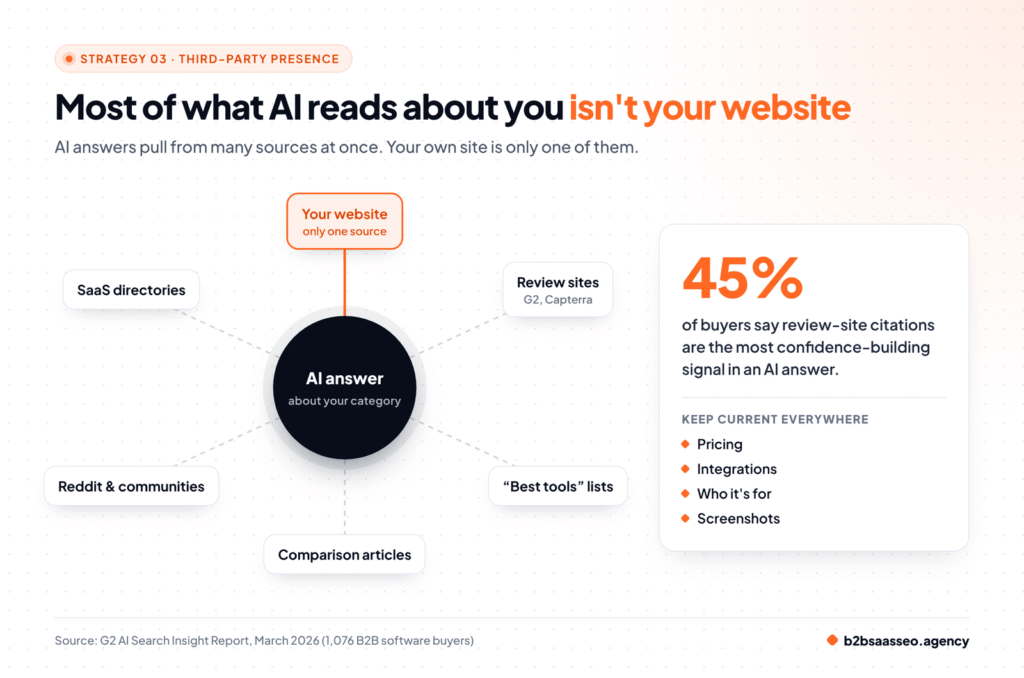
Get listed on the review sites, “best tools” lists and comparison articles your buyers read. AI tools read those pages too, so your own website is only part of what shapes their answer.
In G2’s 2026 survey, 45% of buyers said review-site citations were the most confidence-building signal in an AI answer, more than any other. Here’s where to show up:
- Review sites and directories. Complete and refresh your G2 and Capterra profiles and the SaaS directories your category uses. Old screenshots and last year’s pricing hurt you twice: with buyers and with AI.
- “Best tools” lists. Search for “best” plus your category name in Google, and ask ChatGPT the same. List every page that comes up and whether you’re on it. Then pitch the authors with a real reason to include you. Earning a spot (and a link) on relevant, editorial pages is what our SaaS link building team does.
- Communities. Answer questions on Reddit and in niche Slack groups as a person, not an ad, and say who you work for.
Never buy fake reviews, or links from networks built to sell them. It breaks platform rules and can get your site penalized, which is a hard way to learn the lesson.
- Best for: any product with customers who can review it.
- Skip it if: you don’t have customers yet. Get them first.
- First step: search “best” plus your category in Google and ChatGPT, and list every page you’re missing from.
Strategies 4 to 6: get known before buyers search
4. Is your content made for buyers or for traffic?
Write content that helps a buyer make a decision, not content that only collects visits. A post that brings 10,000 readers and no demos is a cost, not an asset.
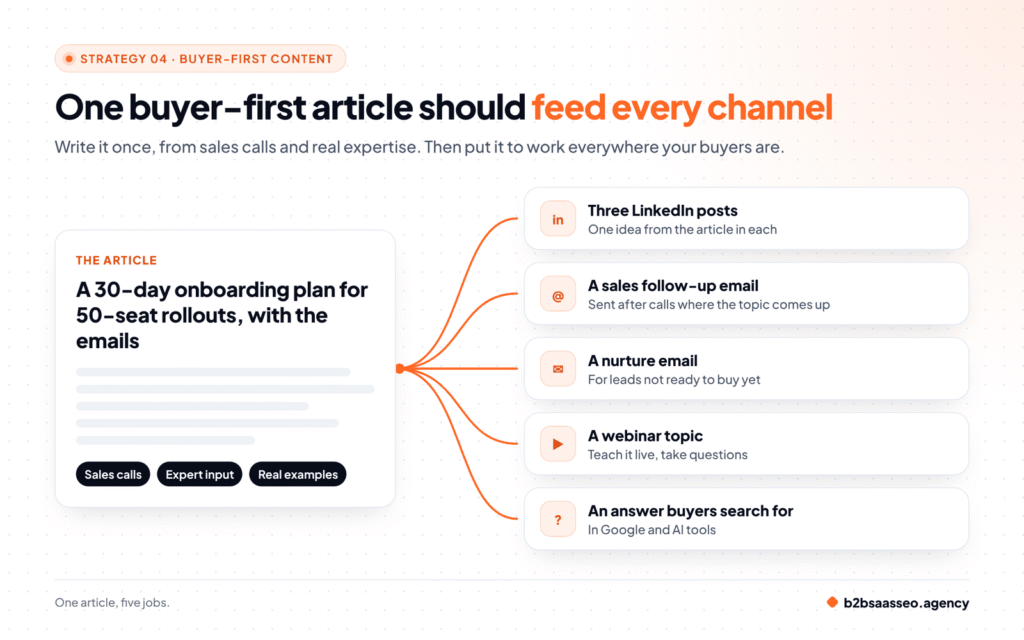
Buyer-first SaaS content comes from your sales calls, support tickets and customer interviews, not only from keyword tools. It says something only your team can say: a strong opinion, real numbers, a template people can use, or a teardown of how customers actually solve the problem.
| Traffic-first content | Buyer-first content |
|---|---|
| “What is customer onboarding? 10 tips” | “A 30-day onboarding plan for 50-seat rollouts, with the emails” |
| Written by whoever has time | Built from sales calls and an expert’s input |
| Measured by pageviews | Measured by demos and how often sales uses it |
| Stock images | Real screenshots, data and examples |
This overlaps with SEO, but it isn’t the same thing. Good content also feeds your LinkedIn posts, sales follow-ups and nurture emails. A post that sales sends to prospects every week is doing its job, even if it never ranks.
- Best for: teams with something real to say: experts, data or strong customer stories.
- Skip it if: the plan is “four generic posts a month”. That budget does more as one great comparison page.
- First step: ask sales for the ten questions prospects ask most, and answer one each week.
5. Is your founder showing up on LinkedIn?
If your buyers read LinkedIn, a founder who posts about the problem your product solves builds trust faster than any company page. A logo announcing a feature gets scrolled past. A founder explaining why they built it, and what they got wrong first, gets read.
What works:
- Post two or three times a week, one idea per post.
- Share opinions, lessons and numbers from building the company, not product announcements.
- Spend as much time commenting on your buyers’ posts as writing your own.
This depends on one person’s time and voice. If the founder stops, the channel stops. And likes aren’t pipeline, so track DMs, demo requests that mention a post, and inbound from people who follow the founder.

- Best for: seed to Series A teams, where the founder is the brand.
- Skip it if: your founder dislikes writing and won’t keep it up for six months. Forced posts read as forced.
- First step: write down ten opinions about your market that a competitor would argue with. That’s your first ten posts.
6. Who already sells to your buyers?
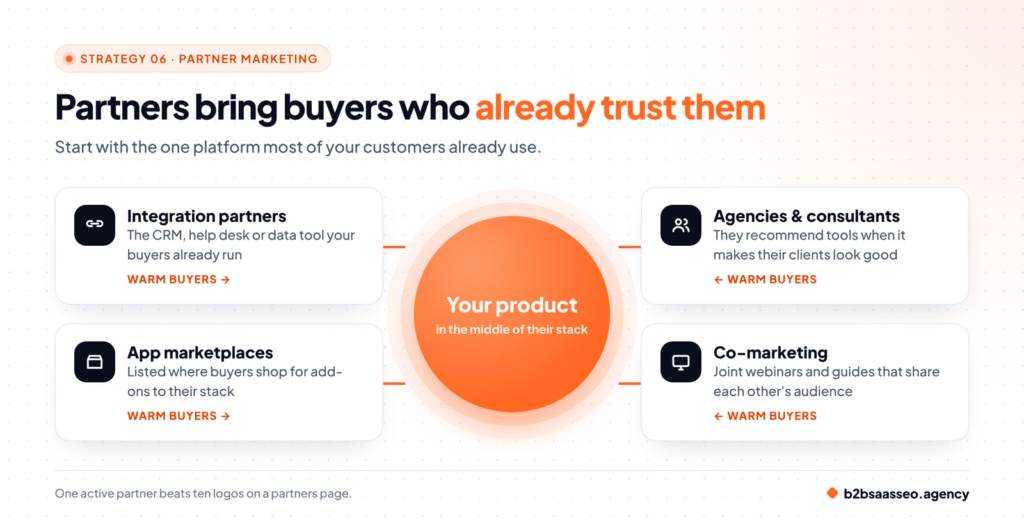
Partner with the tools and firms your buyers already trust. Integration partners, app marketplaces, agencies and consultants can send you buyers who arrive warm.
Three ways in:
- Integrations. Build or polish the integration with the platform most of your customers use, then get listed in its app marketplace.
- Co-marketing. Run a joint webinar or guide with an integration partner, and share each other’s audiences.
- Referral partners. Agencies and consultants who set up tools for your buyers will recommend you if it makes their client look good, and if you make it easy for them.
Partnerships are slow to set up and easy to neglect. One active partner beats ten logos on a partners page.
- Best for: products that plug into a bigger platform, like a CRM, help desk or data warehouse.
- Skip it if: you have no integrations and none on the roadmap.
- First step: find the one platform most of your customers use, and ask its partner team what co-marketing they offer.
Strategies 7 to 10: turn interest into pipeline
7. Should you pay for clicks while SEO grows?
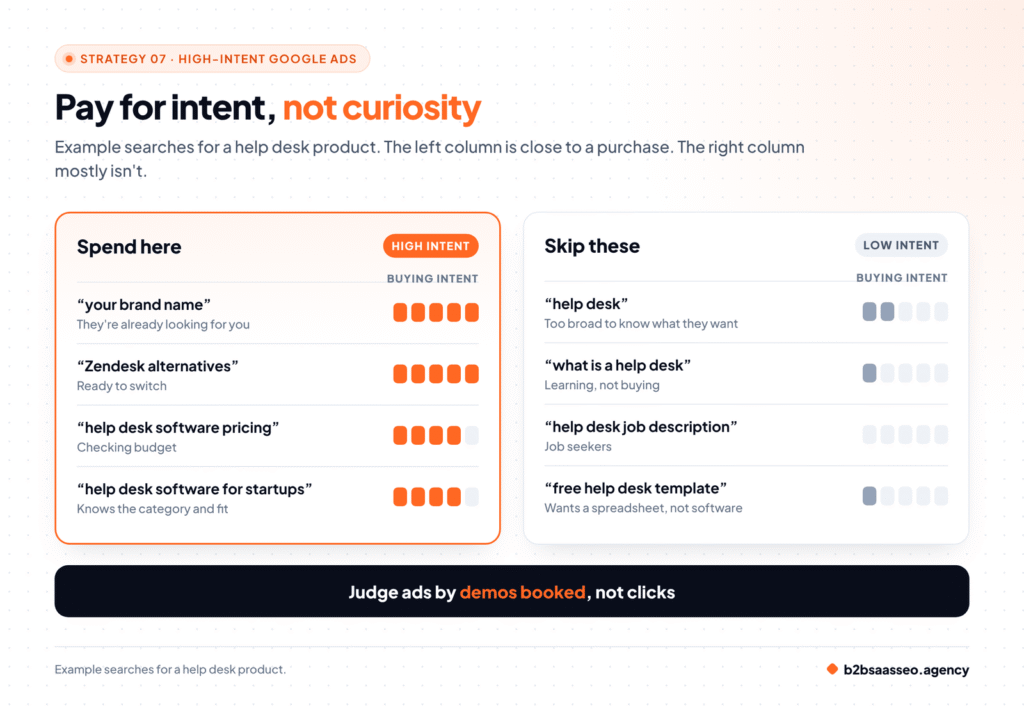
Yes, but only on searches that show buying intent: your own brand name, competitor alternatives, category terms like “help desk software”, and pricing searches. Ads are the renting side of rent versus own: fast, useful, and gone the day you stop paying.
Do it like this:
- Start narrow. Bid on a few high-intent searches, not broad terms like “CRM” that pull in students and job seekers.
- Send each ad to a matching page. An alternatives ad goes to your alternatives page, not your homepage.
- Judge ads by demos booked, not clicks.
There’s a useful side effect. Within weeks, ads show you which searches turn into demos, which tells you which SEO pages to build first.
- Best for: teams with some budget who need pipeline this quarter.
- Skip it if: your deal size is so small that a few clicks cost more than a customer pays you.
- First step: run ads on your brand name and your top three competitor-alternative searches only, for 30 days, and count demos.
8. Are you chasing the accounts you actually want?
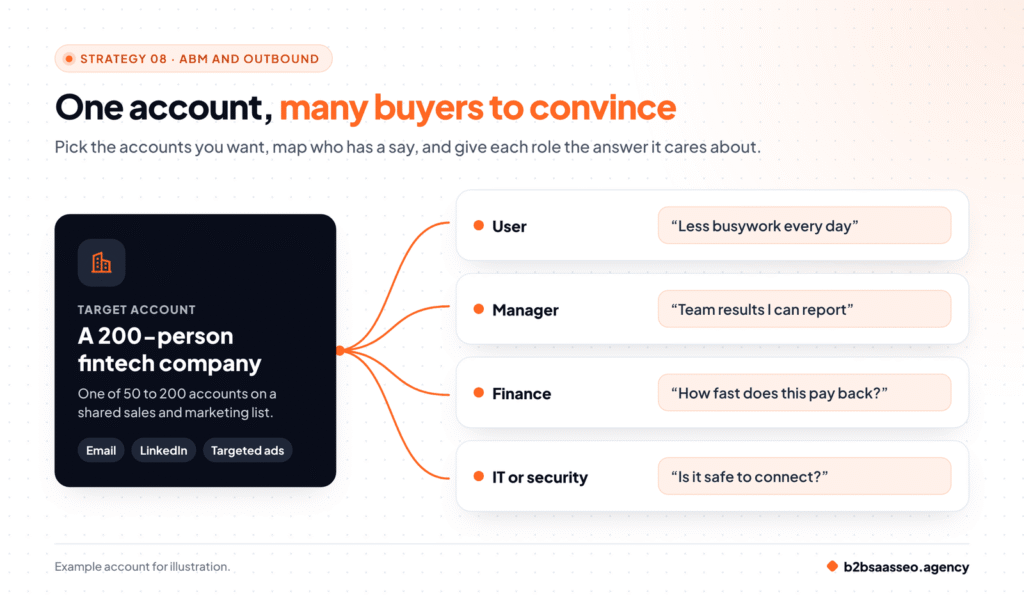
For bigger deals, pick a named list of target companies and reach everyone who has a say in the purchase. That’s account-based marketing (ABM), usually run hand in hand with outbound.
How it works:
- List 50 to 200 companies that closely match your ICP.
- Map the three to five roles involved in buying at each one: the user, their manager, finance, and IT or security.
- Give each role the message it cares about. Users want less busywork. Finance wants payback. IT wants to know it’s safe.
- Reach them by email, LinkedIn and targeted ads, with sales and marketing working from the same list.
- Best for: sales-led teams with larger contracts, usually from Series A on.
- Skip it if: you sell self-serve at low prices.
- First step: pick your 50 best-fit accounts and check which already show interest: site visits, trials or past conversations.
9. Can buyers try it before they talk to sales?
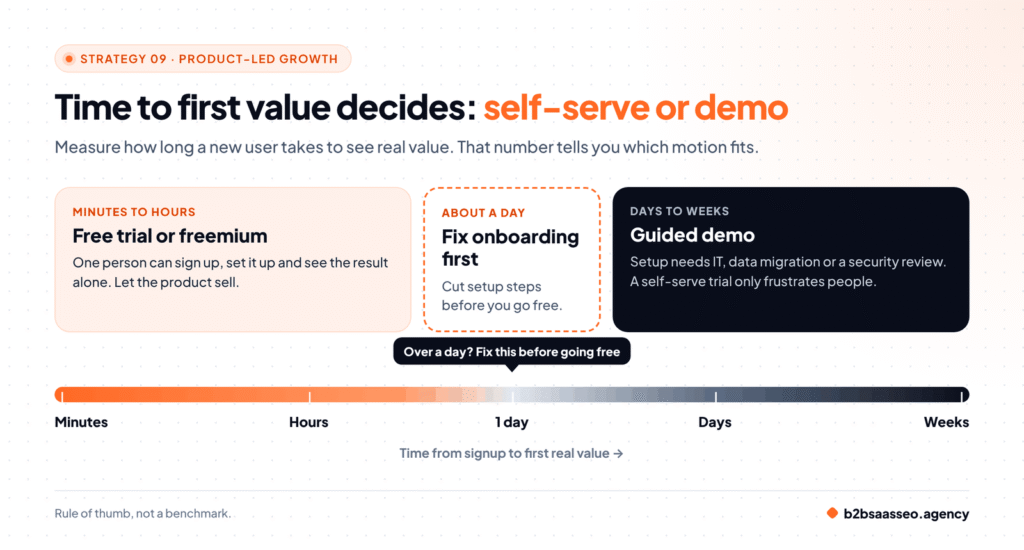
If your product shows its value in minutes, let people try it. A free trial, a freemium plan or a free tool can sell better than any demo, because the buyer sees the result for themselves. This is product-led growth (PLG).
| Model | What it is | Works when |
|---|---|---|
| Free trial | The full product for a set time, such as 14 days | Value shows up well inside the trial window |
| Freemium | Free forever, with limits | One person gets value alone, and teams upgrade as they grow |
| Free tool | A small tool that does one job, like a calculator or checker | You want reach before people are ready for the full product |
Track your activation rate: the share of new signups who reach their first moment of real value. Signups alone mean little.
Free plans also attract people who’ll never pay. And if setup needs IT, a data migration or a security review, a self-serve trial only frustrates people; a guided demo works better.
- Best for: products one person can set up and get value from quickly.
- Skip it if: nothing works until after onboarding calls and integrations.
- First step: time how long a new user takes to reach first value. If it’s more than a day, fix that before you go free.
10. Should you run webinars and small events?
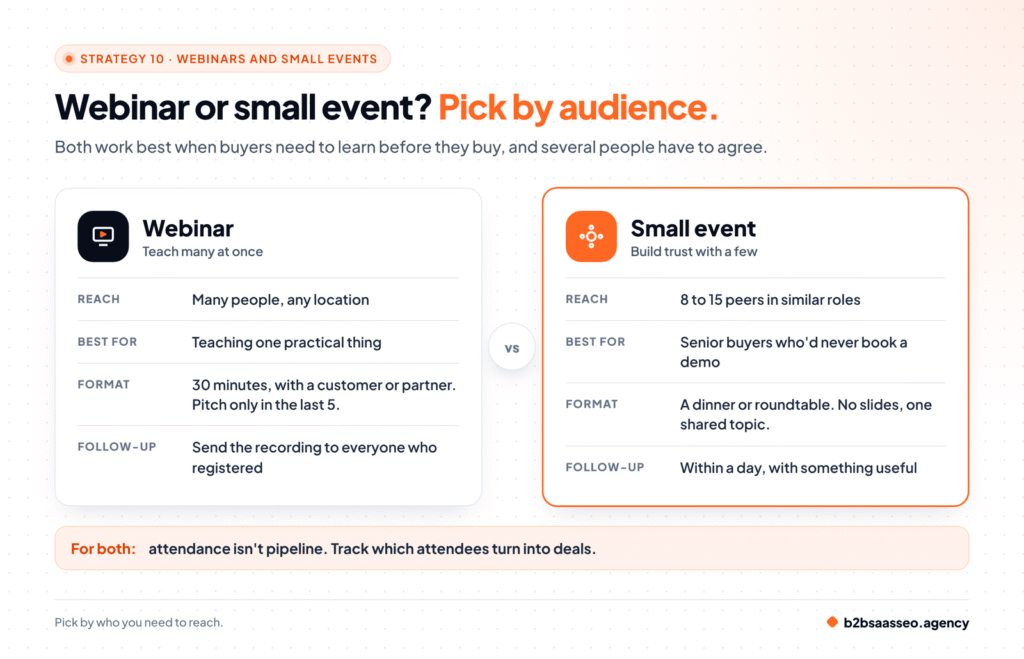
Yes, when buyers need to learn before they buy and several people have to agree. A webinar teaches many people at once. A small dinner or roundtable builds trust with a few, and a room of peers can reach a busy VP who’d never book a demo.
Keep both useful:
- Webinars: teach one practical thing, bring a customer or partner, keep the pitch to the last five minutes, and send the recording to everyone who registered.
- Small events: 8 to 15 people in similar roles, no slides, one topic they all care about.
Attendance isn’t pipeline. Follow up within a day with something useful, and track which attendees turn into deals.
- Best for: complex products and purchases where several people sign off.
- Skip it if: a two-minute video can explain your product.
- First step: turn the question prospects ask most on sales calls into a 30-minute live session.
Strategies 11 and 12: keep and grow
11. What happens after someone signs up?
Onboarding and lifecycle emails decide who stays past the first month. In a subscription business, that’s where the money is: a customer who leaves early may never repay what it cost to win them.
Set it up in three steps:
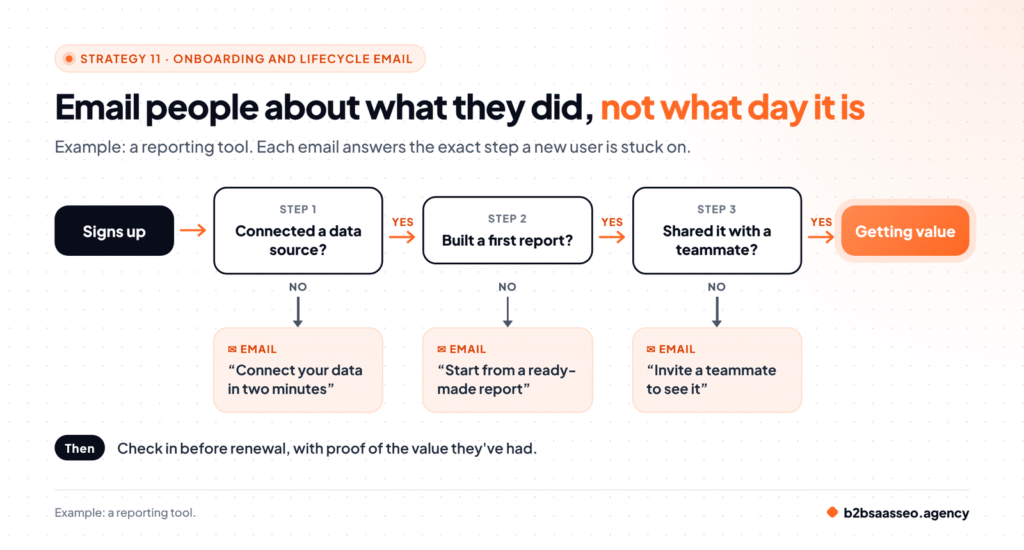
- List the three to five actions a new user must take to get value. For a reporting tool, that might be: connect a data source, build a first report, share it with a teammate.
- Send emails based on what users do, or don’t do, not on a fixed calendar. Someone who connected their data but never built a report needs a different email from someone who never logged back in.
- Check in before renewal, with proof of the value they’ve had.
More emails isn’t better. One email about the exact step a user is stuck on beats a weekly newsletter.
- Best for: any team with new users or customers every week.
- Skip it if: you win only a handful of customers a month. Onboard each one personally instead, and you’ll learn more.
- First step: find the step where most new users drop off, and write one email for that moment.
12. Are happy customers helping you sell?
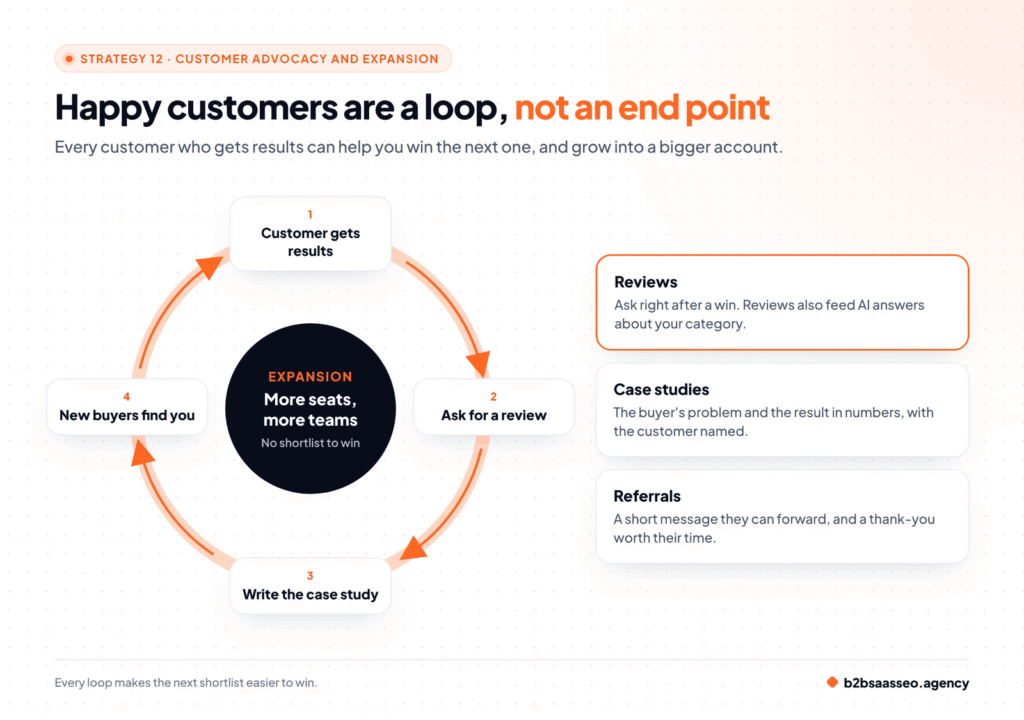
Your happiest customers are your most trusted channel. Turn them into reviews, case studies, referrals and bigger accounts.
- Reviews: ask right after a win, such as a strong first month or a renewal. Reviews also feed the AI answers from strategy 3.
- Case studies: lead with the buyer’s problem and the result in numbers, and name the customer if they agree. A case study that matches a search like “time tracking software for law firms” can double as a bottom-of-funnel page.
- Referrals: make it easy, with a short message they can forward and a thank-you that’s worth their time.
- Expansion: more seats, more teams, a higher plan. This revenue comes from people who already trust you, so there’s no shortlist to win. It shows up in your net revenue retention.
A case study with no numbers about an unnamed “Company X” convinces nobody. Ask for permission to name customers early, ideally when the deal closes.
- Best for: any team with customers who’d vouch for them.
- Skip it if: your customers aren’t seeing results yet. Fix that first; no review campaign can cover it.
- First step: list your ten happiest customers and ask three of them for a review this month.
Which strategies fit your stage?
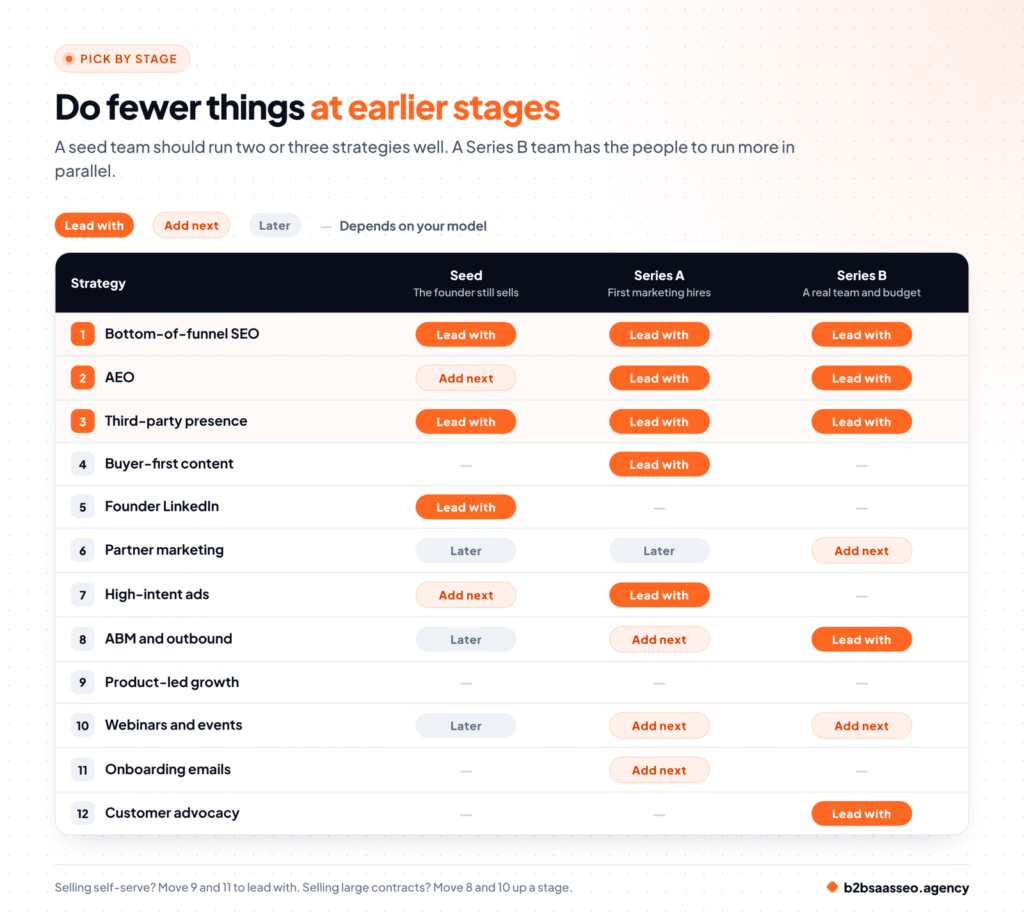
Do fewer things at an earlier stage. A seed team should run two or three strategies well. A Series B team has the people to run more in parallel.
| Stage | Lead with | Add next | Leave for later |
|---|---|---|---|
| Seed (the founder still sells) | Bottom-of-funnel SEO (1), founder LinkedIn (5), reviews and listings (3) | Brand and alternatives ads (7), AEO checks (2) | ABM (8), partner programs (6), events (10) |
| Series A (first marketing hires) | The search engine (1 to 3), high-intent ads (7), buyer-first content (4) | Onboarding emails (11), webinars (10), a small ABM pilot (8) | Large partner programs (6) |
| Series B (a real team and budget) | The search engine (1 to 3), ABM and outbound (8), customer advocacy (12) | Partners (6), events (10) | Anything that doesn’t show up in pipeline |
Two adjustments:
- Selling self-serve? Move product-led growth (9) and onboarding (11) into “Lead with”. Your product is part of your marketing.
- Selling large contracts? Move ABM (8) and events (10) up a stage. Buying groups need more than one touch.
Want a second opinion on your first three? Book a strategy call and bring your current plan.
What does a 90-day B2B SaaS marketing plan look like?
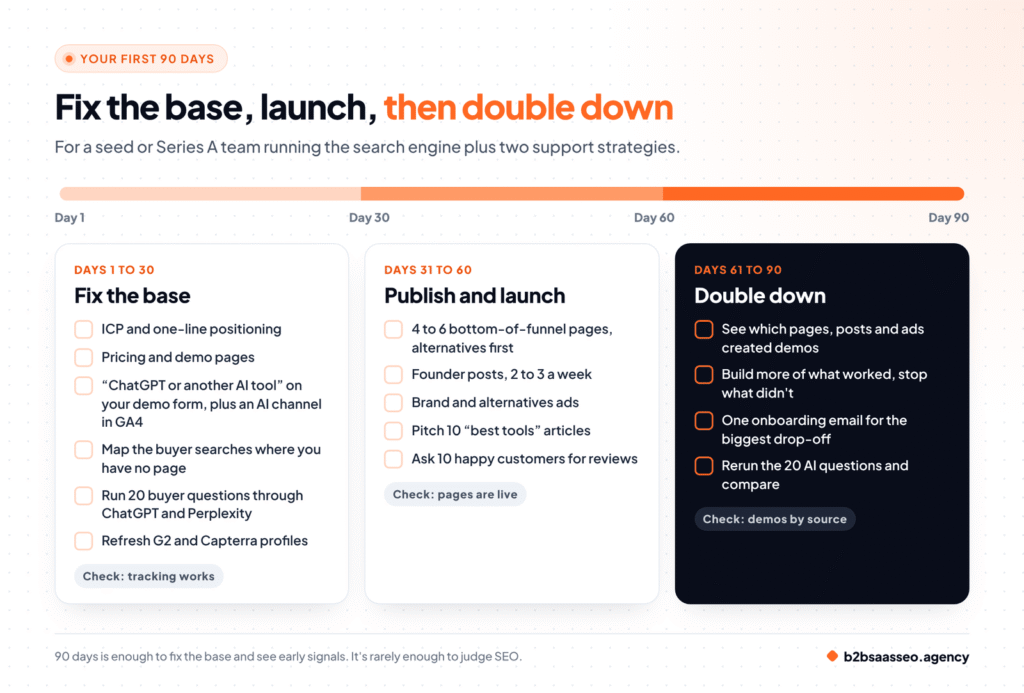
Spend the first 30 days fixing the base, the next 30 publishing and launching, and the last 30 doubling down on whatever brought pipeline. This version suits a seed or Series A team running the search engine plus two support strategies.
Days 1 to 30: fix the base
- Write your ICP and one-line positioning.
- Fix the pricing and demo pages.
- Add “ChatGPT or another AI tool” to the “How did you hear about us?” field on your demo form, and set up a channel for AI traffic in GA4.
- List the buyer searches where you have no page: alternatives, comparisons, use cases.
- Run your 20 buyer questions through ChatGPT and Perplexity to get a starting point.
- Refresh your G2 and Capterra profiles.
Days 31 to 60: publish and launch
- Publish four to six bottom-of-funnel pages, starting with alternatives pages for your top competitors.
- Start founder posts, two or three a week.
- Launch brand and alternatives ads.
- Pitch your product to ten “best tools” articles in your category.
- Ask ten happy customers for reviews.
Days 61 to 90: double down
- Check which pages, posts and ads created demos, not just visits.
- Build more of what worked, and stop what didn’t.
- Write one onboarding email for the step where most new users drop off.
- Rerun your 20 AI questions and compare with day one.
Be realistic about what 90 days proves. It’s enough to fix the base and see early signals from ads, outbound and LinkedIn. It’s rarely enough to judge SEO, which is why the plan tracks demos by source from day one.
How do you know your marketing strategy is working?
Track pipeline by channel, not traffic. Visits and likes are early signals. Demos, pipeline and revenue are the result.
| Metric | What it tells you | How to get it |
|---|---|---|
| Demo requests by source | Which strategies create real buying interest | A required “How did you hear about us?” field, plus the first-touch source in your CRM |
| Pipeline and revenue by channel | What each strategy is worth in money | Tag every opportunity with its source and review monthly |
| Demo rate of bottom-of-funnel pages | Whether search visitors turn into demos | Demos ÷ visits, page by page |
| AI mention rate | How often AI tools name you for your buyer questions | Your 20 questions, run several times each month |
| CAC payback period | Months until a customer repays what it cost to win them | Cost to win one customer ÷ the gross profit they bring in each month |
| Net revenue retention | Whether customers stay and grow | This year’s revenue from last year’s customers ÷ what they paid last year |
Two warnings. First, self-reported sources are messy, but they’re often the only trace of AI influence: many buyers read an AI answer, then come back days later by typing your URL. Our glossary entry on organic pipeline attribution covers how to connect the dots. Second, give each strategy a fair window before you judge it: weeks for ads, months for SEO. If running the AI questions by hand gets heavy, these AI visibility tools can do it for you.
Frequently Asked Questions (FAQs)
We tried SEO before. We got traffic but no demos. What went wrong?
Usually the targets. The pages often chased “what is” searches that bring readers, not buyers. Add pages with no clear next step and no tracking by source, and SEO looks like it failed when it was simply aimed at the wrong people. Start again with bottom-of-funnel pages (strategy 1) and judge them by demos, not visits.
ChatGPT already recommends our competitor. Can we change that?
Often, yes, but slowly. Look at the sources the answer cites, because they show where the AI gets its view. Then get your product onto those pages, publish a fair comparison against that competitor, and make the facts on your own site easy to quote. Check monthly, not daily, since answers vary from run to run. Nobody can promise you’ll replace them in the answer.
Do we still need SEO if buyers are moving to AI chatbots?
Yes. AI tools pull most of what they cite from search results (88% for ChatGPT in Ahrefs’ study), and about 80% of software buyers still use Google at some point (G2). The two work together rather than against each other. For the longer version, read Is SEO dead?
How should we split budget between SEO and paid ads?
There’s no right ratio, and anyone who quotes one without seeing your numbers is guessing. Decide by urgency. If you need pipeline this quarter, paid carries more of the load early. As your bottom-of-funnel pages start bringing demos, shift budget toward organic, and keep brand and alternatives ads running.
How long until SEO brings demos, not just traffic?
It depends on your site’s authority, your competition and how many decision-stage pages you publish. Pages for low-competition comparison and alternatives searches can start bringing demos within a few months. Broad category terms in crowded markets usually take much longer. Track demos per page from day one so you spot the first signals early.
We’re a team of five. Can we really do SEO, AEO and LinkedIn at once?
Yes, if you keep each one small: one bottom-of-funnel page a week, founder posts twice a week, and a monthly check of your 20 AI questions. Leave the rest of this list until those three bring demos. Depth in three strategies beats a thin layer of twelve.
What should you do next?
Start where the shortlist starts. This week, Google your top competitor’s name plus “alternatives”, then ask ChatGPT which tools it recommends in your category. If you’re missing from both, strategies 1 to 3 are your first 90 days.
Want a second pair of eyes on it? Book a strategy call. We’ll review your competitors and your AI visibility with you, and you keep the 90-day plan either way.